Sanders & technique · 3 min read
Random orbital sander or orbital sander – which is better?
The random orbital sander covers area, the orbital sander gets into corners. Motion, removal, abrasives and use compared – for wood, doors and drywall.
Last updated:
KORNDEX sells abrasives – matching products are linked below the article.

The motion makes the difference
On a random orbital sander the round pad rotates and at the same time oscillates on a small circular path, the orbit. Every grain therefore runs on an ever-changing path, and no directional scratch pattern forms.
On an orbital sander a rectangular plate oscillates on a small circular path but does not rotate. The motion is smaller and more uniform, the removal lower – but the plate stays where you guide it.
Removal and surface
The random orbital sander removes considerably more and is much faster on large surfaces – table tops, door leaves, body filler, paint. Despite the speed the surface ends up fine, because the scratches run every which way.
The orbital sander works more slowly and gently. On wood it leaves fine swirls, which a last pass by hand along the grain takes out. It is too weak for stock removal, but enough for smoothing and keying.
Corners, edges, frames
This is where the orbital sander wins: with the rectangular plate you get right up to inside edges, into frame corners and along mouldings. The round pad of the random orbital sander leaves a remainder in every inside corner, and on edges it tilts slightly and sands through.
Abrasives: disc or sheet
A random orbital sander takes a round hook-and-loop disc the size of its pad, usually 125 or 150 mm, with a matching hole pattern. The orbital sander takes rectangular cuts: on hook-and-loop plates, strips or sheets with hook and loop; on clamp plates, paper from the roll held under clamps. The manual says which format.
Which for wood, doors and drywall
Furniture, table tops, door leaves, sections of floorboards: the random orbital sander. Door frames, window frames, panels and mouldings: the orbital sander or by hand. For a door the combination is fastest – the surface with the random orbital sander, profiles and corners with strips and a block.
In drywall work the random orbital sander with extraction and a mesh disc is the better choice for filled surfaces; the orbital sander is enough for small spots and corners. For whole walls and ceilings there are dedicated long-reach drywall sanders.
Compared at a glance
Motion: random orbital rotates and oscillates – orbital only oscillates. Removal: random orbital high – orbital low. Corners: random orbital cannot get in – orbital reaches the inside edge. Abrasive: random orbital round hook-and-loop disc – orbital sheet or strip. Best use: random orbital large surfaces and paint – orbital frames, edges and light keying.
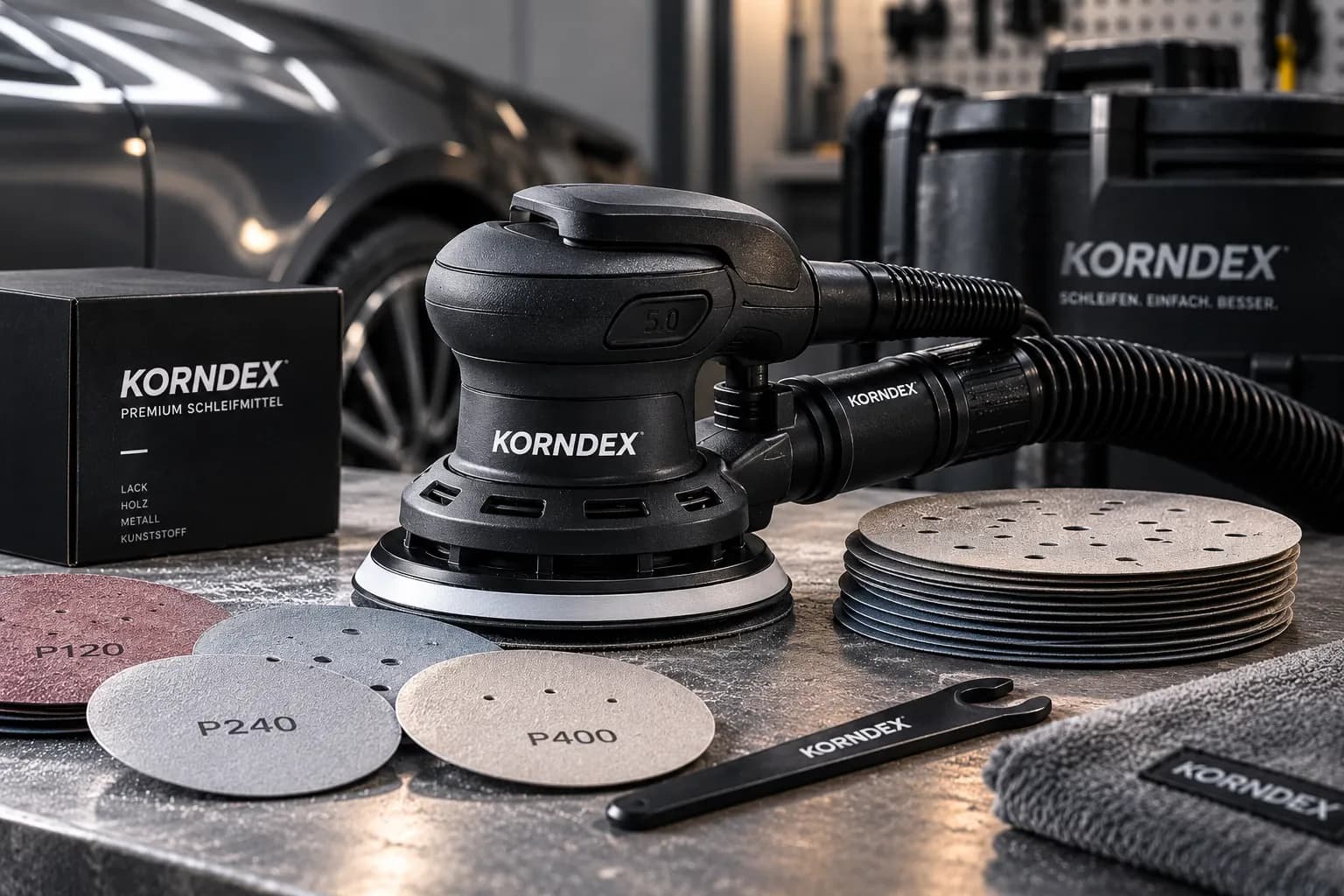
If you only buy one machine, take the random orbital sander: it covers wood, paint and body filler, and you do the corners by hand. The random orbital sander in the shop is the KORNDEX EX 150 with a 150 mm pad and a 5 mm orbit.
Random orbital, delta or by hand – what for corners?
The delta sander has a triangular plate that only oscillates – with it you get into sharp corners, at glazing bars and inside furniture. But it removes little, and the tip of the sanding sheet wears quickly.
For the few corners on a door or a piece of furniture, your hand is enough: a sanding strip on the hand block for straight edges, a piece of strip folded around a finger for the corner, a non-woven pad for profiles and curves.
FAQ
Which is better for wood?
For surfaces the random orbital sander – it is faster and leaves no directional scratch pattern. For frames, mouldings and inside corners the orbital sander or the hand block.
Can a random orbital sander replace an orbital sander?
Almost everywhere. Only in inside corners and on narrow frames the round pad cannot reach – you do that with sanding strips and a hand block.
Random orbital or orbital sander for drywall?
For filled surfaces the random orbital sander with extraction and a mesh disc – it is faster and does not clog. For small spots and corners an orbital sander or sanding screen by hand is enough.
Terms in this article
- Random orbital sander
- Orbit (stroke)
- Sheet sander
- Swirl marks
- Grain direction
- Scuff sanding (keying)
- Hole pattern
- Dust extraction
- Detail sander
- Abrasive fleece