Wood · 1 min read
Sanding decking and wooden floorboards: what the random orbital can do
For edges, corners, small areas and refreshing, yes – large floorboard areas are sanded with a belt or floor sander. Which grit and in which order.
Last updated:
KORNDEX sells abrasives – matching products are linked below the article.
What the random orbital sander can do here
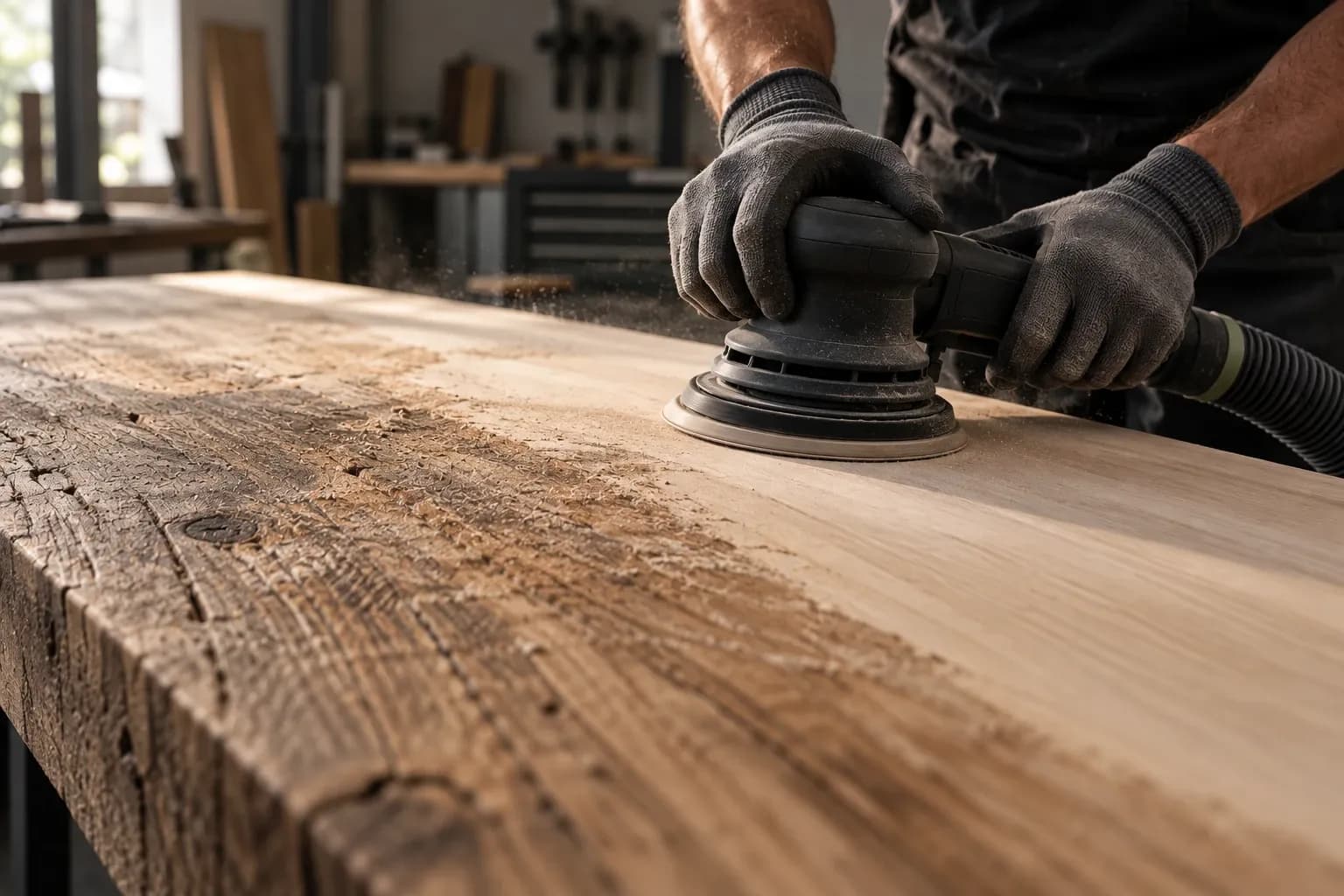
The random orbital sander suits refreshing greyed or rough boards, stair treads, edge areas, corners and small terraces. It sands evenly and without direction but removes less than a belt sander.
Large areas with deep dents, height differences between boards or thick old finishes are sanded with a belt or floor sander, which you can hire. The random orbital is then for the edges and the fine sanding.
Grit: P80, then P120, finally P180
Use P80 to take off old finishes, greying and roughness. Then P120, and finally P180 for a smooth surface that takes oil or glaze. On outdoor decking P80 to P120 is often enough; sanding too fine closes the pores and the oil no longer soaks in well.
Always work along the grain of the boards with little pressure so no hollows form. Countersink screw and nail heads beforehand, otherwise they tear the sandpaper.
Dust and safety
Work with dust extraction and wear a dust mask. Hardwood dust in particular irritates the airways; notes on extraction and masks are in the guide on sanding dust.
After sanding
Remove dust thoroughly, dampen the surface as needed and lightly take down fine raised fibres with P180. Then oil or glaze while the wood is dry and clean.
FAQ
Which grit for decking?
P80 to take off greying and old finishes, then P120 and, for indoor floors, P180 at the end. Outdoors P80 to P120 is often enough.
Is a random orbital sander enough for a wooden floor?
For edges, corners, small areas and refreshing, yes. Large areas are sanded with a belt or floor sander.
Terms in this article
All terms in the sanding glossary →The whole sequence at once
3 grits, 1 × smallest pack each: PRO CUT 150 (10 pcs) P80 · P120 · P180.
Or as a set: Wood starter set (P80–P240) for €49.90 →
incl. VAT, plus shipping