Wood · 2 min read
Sanding between coats: when, with what, which grit?
P240 to P320 between coats of wood varnish, P320 to P400 for fine lacquers – only key the surface, do not sand through, and let it dry properly first.
Last updated:
KORNDEX sells abrasives – matching products are linked below the article.
Why sand between coats
After the first coat the wood fibres stand up: the surface feels rough even though it was smooth before. On top of that come dust particles that landed in the varnish, and small runs. Sanding between coats takes that off and keys the layer lightly so the next coat holds and flows out smoothly.
You need it between two coats of varnish, between primer and top coat and – more lightly – between two coats of oil.
Which grit between coats
Between coats of wood varnish P240 to P320: fine enough that no scratches show through the next coat, coarse enough for the varnish to hold. For thin, fine lacquers and before the last coat, P320 to P400. Between primer and top coat on furniture, P240 is usually enough.
Sanding between coats should never be coarser than P240: the scratches show in the finished varnish.
Let it dry first
The varnish must be fully cured, not just touch-dry. If the paper smears, small lumps form on it or the surface goes soft while sanding, it is not ready yet – wait another day. The drying time is on the tin and depends on temperature and film thickness.
With what: by hand, by machine, non-woven pad
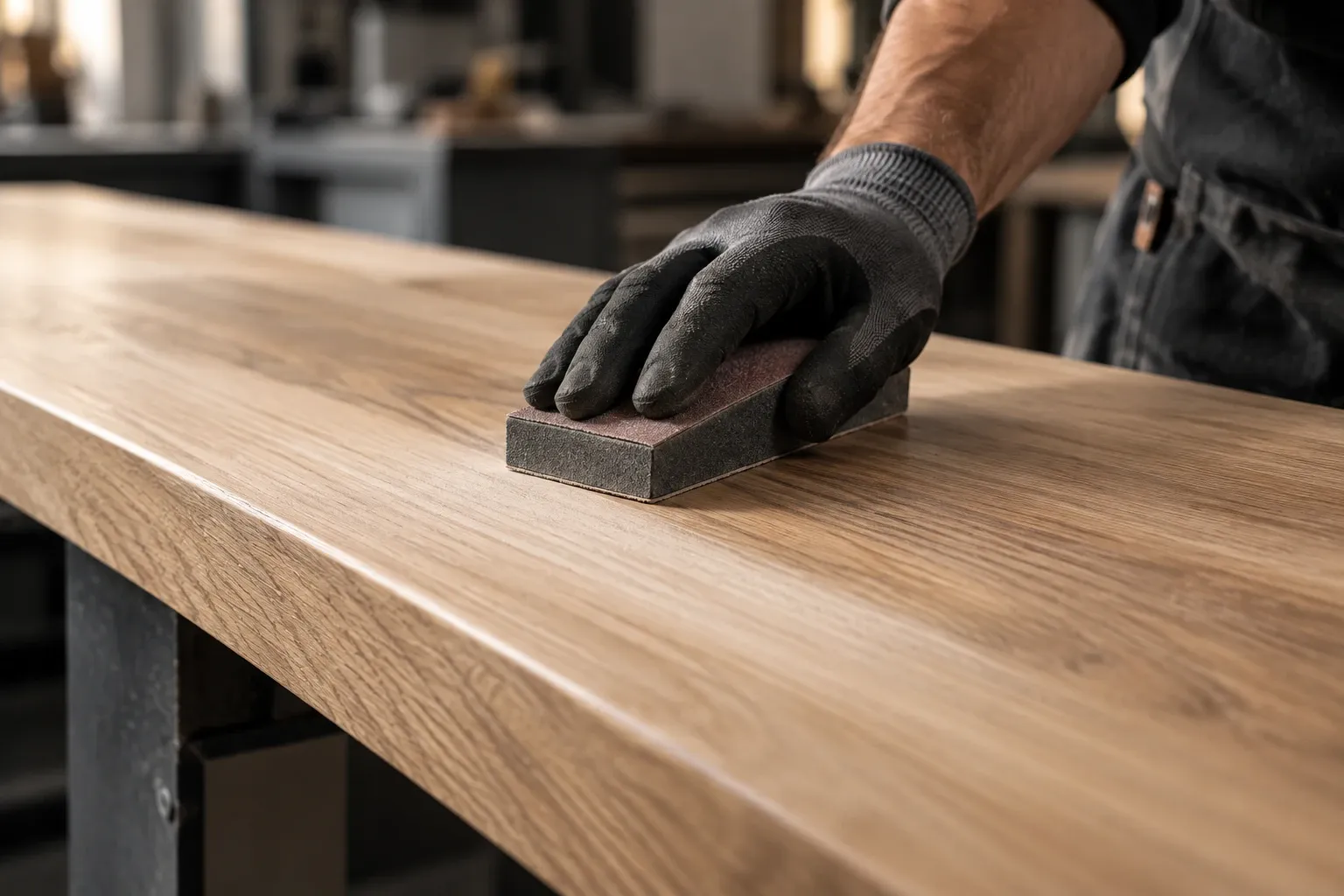
On flat surfaces by hand with the hand block and a sanding strip, along the grain and with light pressure; on large surfaces the random orbital sander with a fine disc at low speed works too. The point is keying, not removing: one or two light passes until the surface is evenly matt everywhere.
On profiles, edges and curves the non-woven pad – it follows the shape and does not sand through on the edge.
Do not sand through – and get rid of the dust
The coat is thinnest on edges. Only go over them with a non-woven pad or very lightly; a sanded-through edge shows as a light line after the next coat. Veneer needs particular care, because there is no wood underneath to sand back into.
Then vacuum the dust thoroughly and wipe with a slightly damp cloth or a tack cloth. Every speck of dust left behind stands up again in the next coat.
FAQ
Do I have to sand between every coat of varnish?
Between primer and varnish and after the first coat of varnish almost always. For further coats only if there is dust or roughness in them, or the manufacturer requires it for adhesion.
Sanding between coats of oil – necessary too?
After the first coat of oil the fibres also stand up. A light sanding with P240 or a fine non-woven pad makes the surface smoother; for further coats of oil a non-woven pad is usually enough.
Terms in this article
- Intermediate sanding
- Primer coat
- Deep scratches
- Grain direction
- Speed
- Scuff sanding (keying)
- Abrasive fleece
- Veneer
The whole sequence at once
3 grits, 1 × smallest pack each: PRO CUT 150 (10 pcs) P240 · P320 · P400.
Or as a set: Wood starter set (P80–P240) for €49.90 →
incl. VAT, plus shipping