Coarse · Heavy stock removal
Sandpaper P60 P60 grit (FEPA)
Rough shaping. Weld seams, rough unevenness, rough-shaping body filler.
Roughly equivalent to 60 Grit (US CAMI standard).
01 · Where it fits
Where P60 sits in the sequence
Before
Pre-sand with P40 – the jump to P60 is no more than double, so the scratches disappear.
Coarse range
P24–P80: Strip old paint, rust and rough unevenness, shape body filler. Leaves visible scratches – always work finer afterwards.
After
Carry on with P80 until the surface is as fine as the next job needs.
P60 in practice
- Used on
- Weld seams on steel, roughly applied filler, weathered wood.
- Tools
- Random orbital sander with 5 mm orbit; filler surfaces with a hand block so they end up flat.
- Typical mistake
- Sanding filler freehand without a block: the surface follows your hand and the dents stay.
- Tip from the workshop
- Apply guide coat: whatever is still dark after sanding sits lower. That way you see dents before they disappear under the primer.
P60: weld seams, rust, rough filler
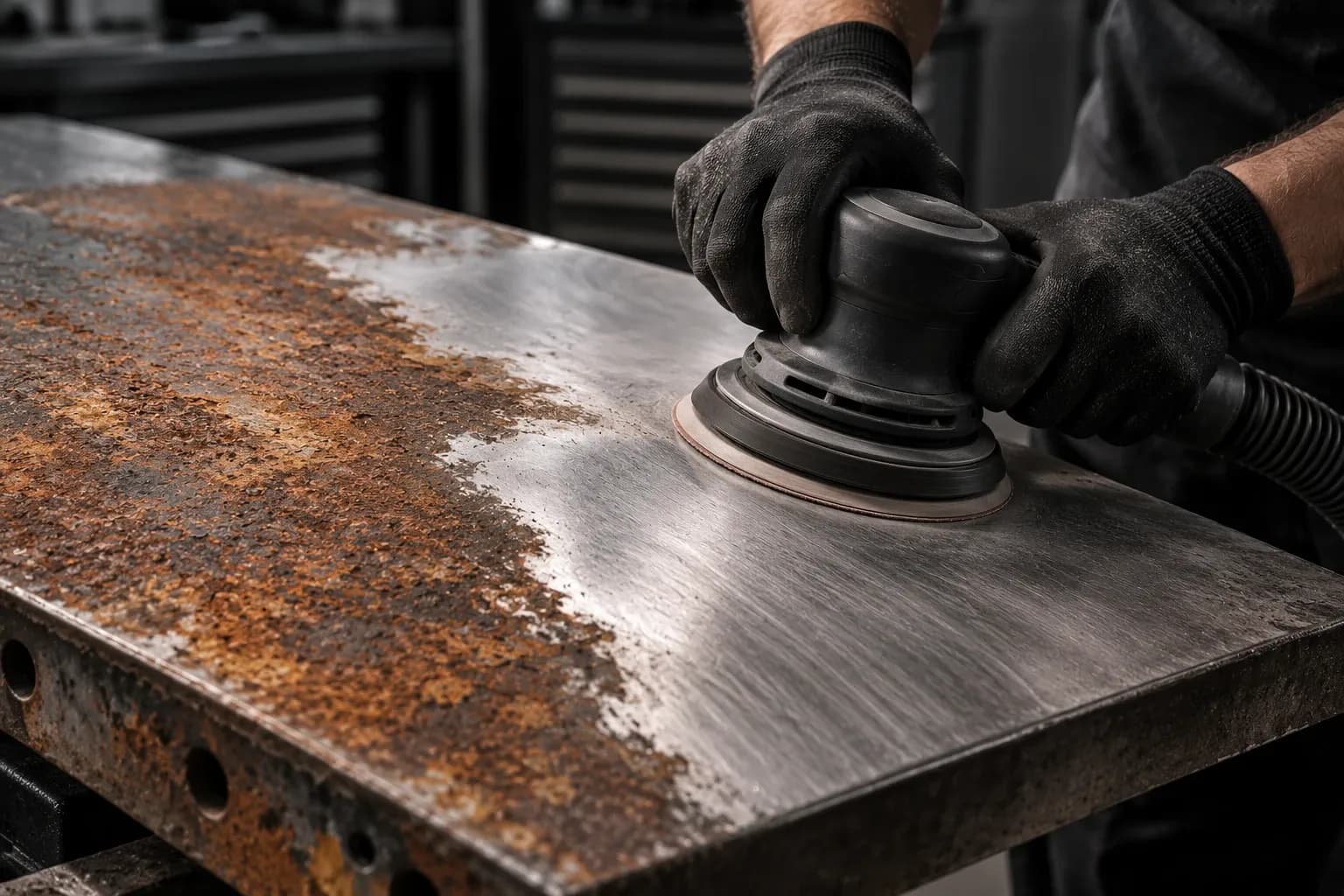
P60 is the grit at which the random orbital sander takes over from the angle grinder: dressing weld seams, sanding out rust pits, roughly shaping freshly applied filler. On thin sheet metal work in passes and do not stay on one spot – the heat warps it. Then smooth the deep scratches with P80 to P120.
Sanding metal: rust and weld seams →All grits in the Coarse range
In the KORNDEX system:Preparation · Remove old paint & rust P40–P120
02 · Buy
Products in P60
03 · Know-how
FAQs about P60
What is P60 sandpaper used for?
Rough shaping: Weld seams, rough unevenness, rough-shaping body filler. Typical for Wood, Metal.
Is P60 coarse or fine?
P60 belongs to the coarse range (P24 to P80): heavy stock removal. The higher the number, the finer the grit.
Which grit comes after P60?
After P60 comes P80. Never more than double the number per step – that way the finer grit removes the scratches of the coarser one.
Should P60 be used wet or dry?
Dry, with dust extraction – up to about P600 that is the standard today: faster, and no water in the metal or wood. Mesh discs and multi-hole patterns stop P60 from clogging.
Which grit comes before P60?
Before P60, sand with P40 (or finer). Jump straight to P60 from too coarse a grit and you won't get the scratches out.
What do you sand P60 with?
Random orbital sander with 5 mm orbit; filler surfaces with a hand block so they end up flat. Typical for: Weld seams on steel, roughly applied filler, weathered wood.
What is the most common mistake with P60?
Sanding filler freehand without a block: the surface follows your hand and the dents stay. Apply guide coat: whatever is still dark after sanding sits lower. That way you see dents before they disappear under the primer.
Related guides
Metal
Sanding metal: which grit for rust, welds and paint?
Removing rust and mill scale, dressing welds, keying bare metal for primer – which grit for what, and how to tell it is too coarse.
P60 → P120 → P240 → P400
Read · 3 minMetal
Derusting and painting railings and garden gates
Loose rust and old paint off with P60 to P80, transitions with P120, key with P180 – bars and corners by hand, with non-woven abrasive or a sanding roll.
P60 → P80 → P120 → P180
Read · 1 min
Not sure P60 is right?
The finder asks about material, machine and goal – and tells you the grit and product.
Start the abrasive finder →