Plastic & resin · 1 min read
Sanding and polishing acrylic: edges and scratches
Smooth sawn edges with P240, then wet up to P2000 and polish – with light pressure, because acrylic heats up quickly and smears.
Last updated: · published
KORNDEX sells abrasives – matching products are linked below the article.
Sanding acrylic (Plexiglas) edges: which grit
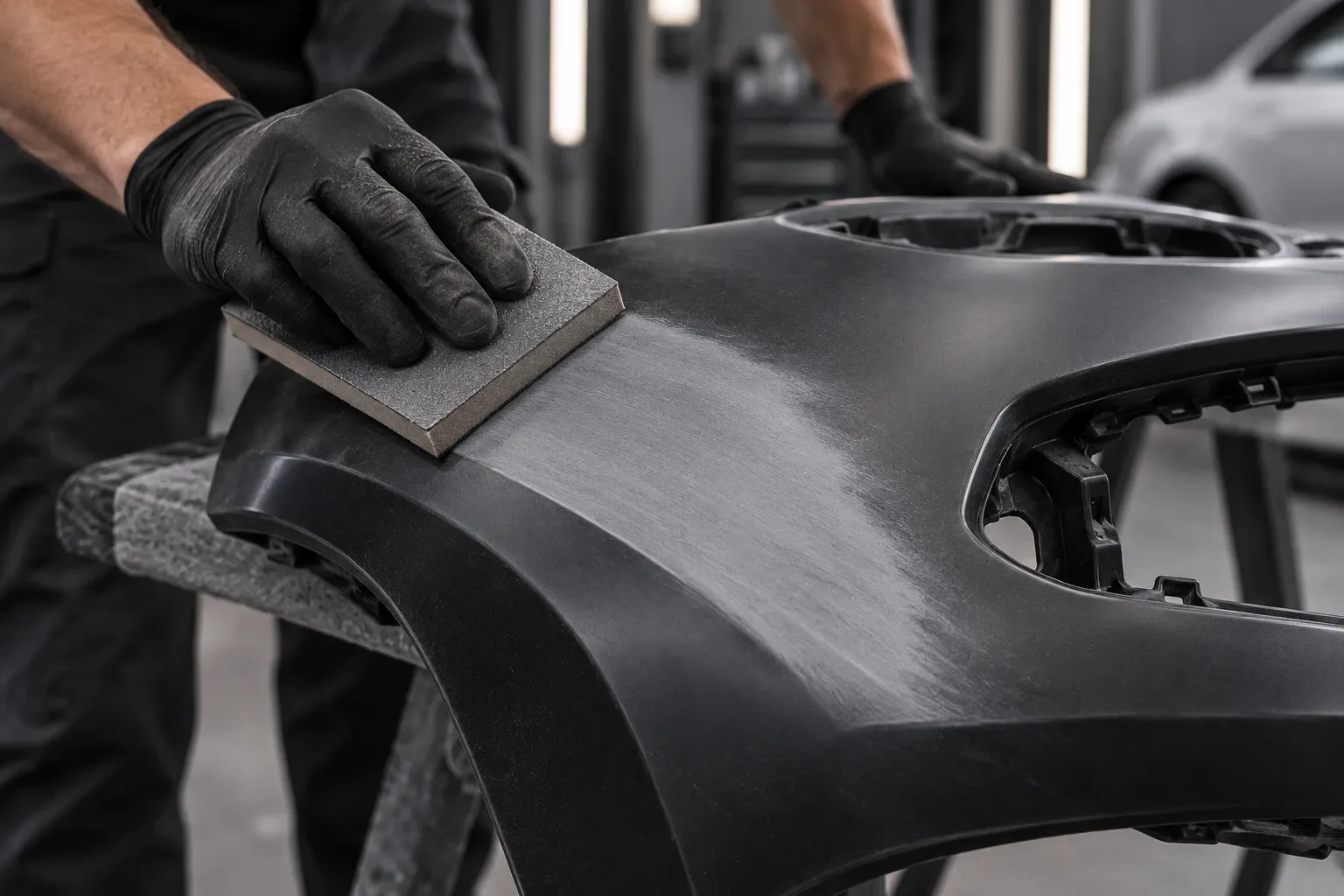
Sawn or milled edges carry scratches that show through the whole part. Level the edge with P240 on a hand block, always lengthways and with the block flat on the edge – that keeps it straight and stops it rounding over. It almost never needs to be coarser than P240; scratches from P120 cost you three extra steps later.
Then P400 and P600, each time until the scratches from the previous step have gone. If you colour the edge with a felt-tip pen between steps, you’ll see at once where old scratches remain.
Fine wet sanding
From P800, sand wet: water with a drop of washing-up liquid cools, rinses away the swarf and stops the grit from clogging. P800, P1000, P1500, P2000 – each step at right angles to the previous one, so you can see when the old scratch pattern has gone. Use the foam pad on flat surfaces and the sheet wrapped round a block on edges.
With a power sander, only at low speed and without pressure: acrylic heats up quickly, smears and develops stress cracks, especially around drilled holes.
Polish instead of sanding further
After P2000 the surface is satin matt. It only becomes clear with polishing compound for plastics – by hand or with a soft polishing sponge at low speed. Light scratches on otherwise intact acrylic often come out with just P1500 to P2000 and polish; treat deep scratches like an edge and start at P400.
FAQ
Does this work the same way with polycarbonate?
In principle, yes – but polycarbonate is softer and tougher: it smears sooner and is harder to get clear when polishing. Start finer, use even less pressure and plenty of water.
Why does the edge go cloudy again after polishing?
Usually there are still scratches from a coarse step underneath, which the polish has only covered up. Go back one step, sand through cleanly, then polish again.
Is Plexiglas the same as acrylic glass?
Yes. Plexiglas is a well-known brand name that is used for acrylic glass (PMMA) in everyday language. You sand edges and scratches the same way on both: from P240 on the block, from P800 wet, then polish.
Terms in this article
All terms in the sanding glossary →The whole sequence at once
7 grits, 1 × smallest pack each: PRO FILM 150 (10 pcs) P240 · P400 · P600 · P800 · P1000 · P1500, PRO SHEET 230 × 280 wet (25 pcs) P2000.
Or as a set: Finish set for high gloss (P1000–P2000) for €59.90 →
incl. VAT, plus shipping