Plastic & resin · 1 min read
Sanding plastic: preparing bumpers properly
Bumpers and trim panels smear, warp and reject paint if you treat them like sheet metal. Grit, pressure and the steps that follow.
Last updated: · published
Why plastic is different
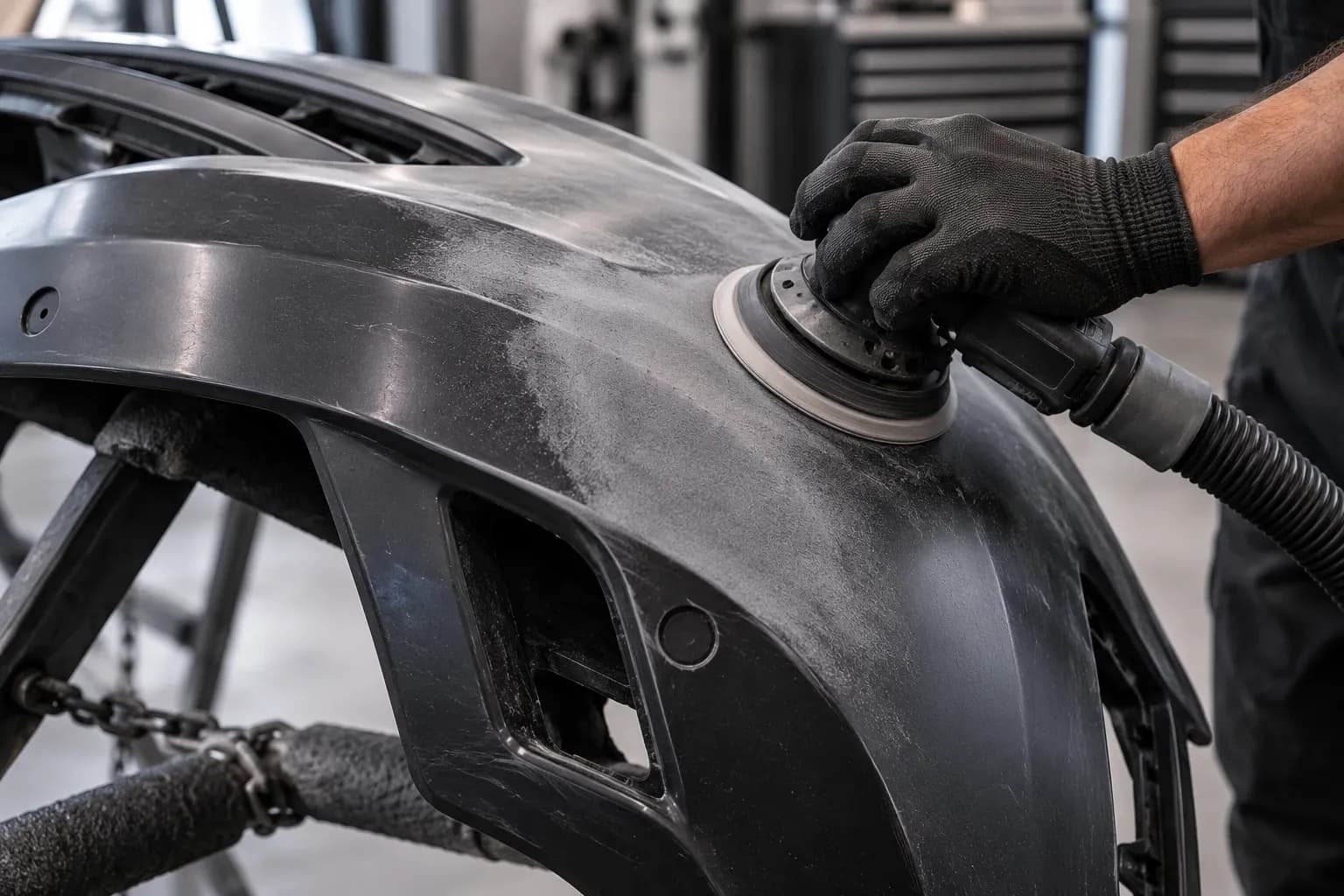
Plastic conducts heat poorly. At high speed and with a lot of pressure the surface softens, the grain clogs, and instead of sanding dust you get fluff and smears. So: a random orbital sander with a small orbit at low speed, light pressure, and change the disc once more rather than once less.
New parts often carry release agent from the mould. Wipe them with plastic cleaner before the first sanding – otherwise the abrasive just rubs it into the surface.
Scratches and damage: P180 to P320
Smooth deep scratches and moulding flash with P180, then remove the scratches with P240 and P320. Coarser than P180 is rarely needed on plastic and leaves scratches you will see in the paint later. Damage that needs filling calls for a plastic filler – normal polyester body filler is too hard and cracks when the part flexes.
Keying before painting: P320 to P400
For new paint, the whole surface must be matt without a single shiny spot: P400 on the random orbital sander on flat areas, and grey non-woven abrasive in edges, swage lines and honeycomb grilles – it follows the contour and does not sand through.
Then clean thoroughly, including with an anti-static cleaner, because plastic attracts dust. On bare plastic, adhesion promoter goes on before the primer; without it, the paint flakes off at the first stone chip.
Unpainted parts: P600 to P1000
Visible parts that will not be painted: fine-sand with a film-backed disc or foam pad from P600 to P1000, preferably wet. The even scratch pattern is the basis for polishing.
FAQ
Do I need adhesion promoter on plastic?
On unpainted plastic almost always – after keying and cleaning, before primer surfacer or paint. On sound existing paintwork, keying is enough.
Why does the plastic go fluffy when I sand it?
It is getting too hot: too much pressure, too high a speed or a blunt disc. Less pressure, a finer grit, change discs more often.
Terms in this article
All terms in the sanding glossary →The whole sequence at once
4 grits, 1 × smallest pack each: PRO NET 150 (10 pcs) P180 · P240 · P320 · P400.
Or as a set: Finish set for high gloss (P1000–P2000) for €59.90 →
incl. VAT, plus shipping