Wood · 2 min read
What grit sandpaper for wood?
P80 for saw marks, P120 to P180 to smooth, P240 before oil and varnish – and why going finer than P240 often does harm.
Last updated: · published
Three steps are usually enough
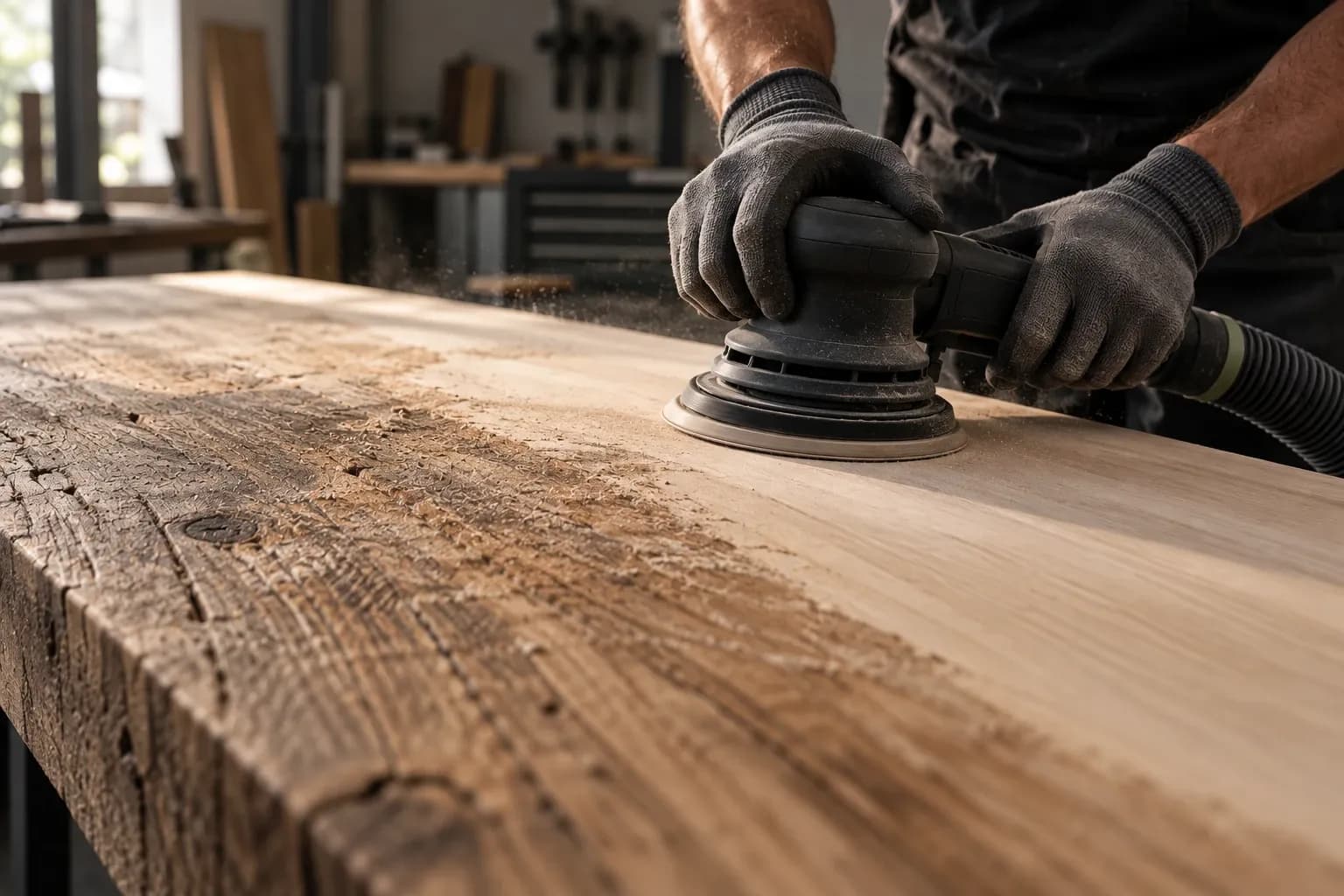
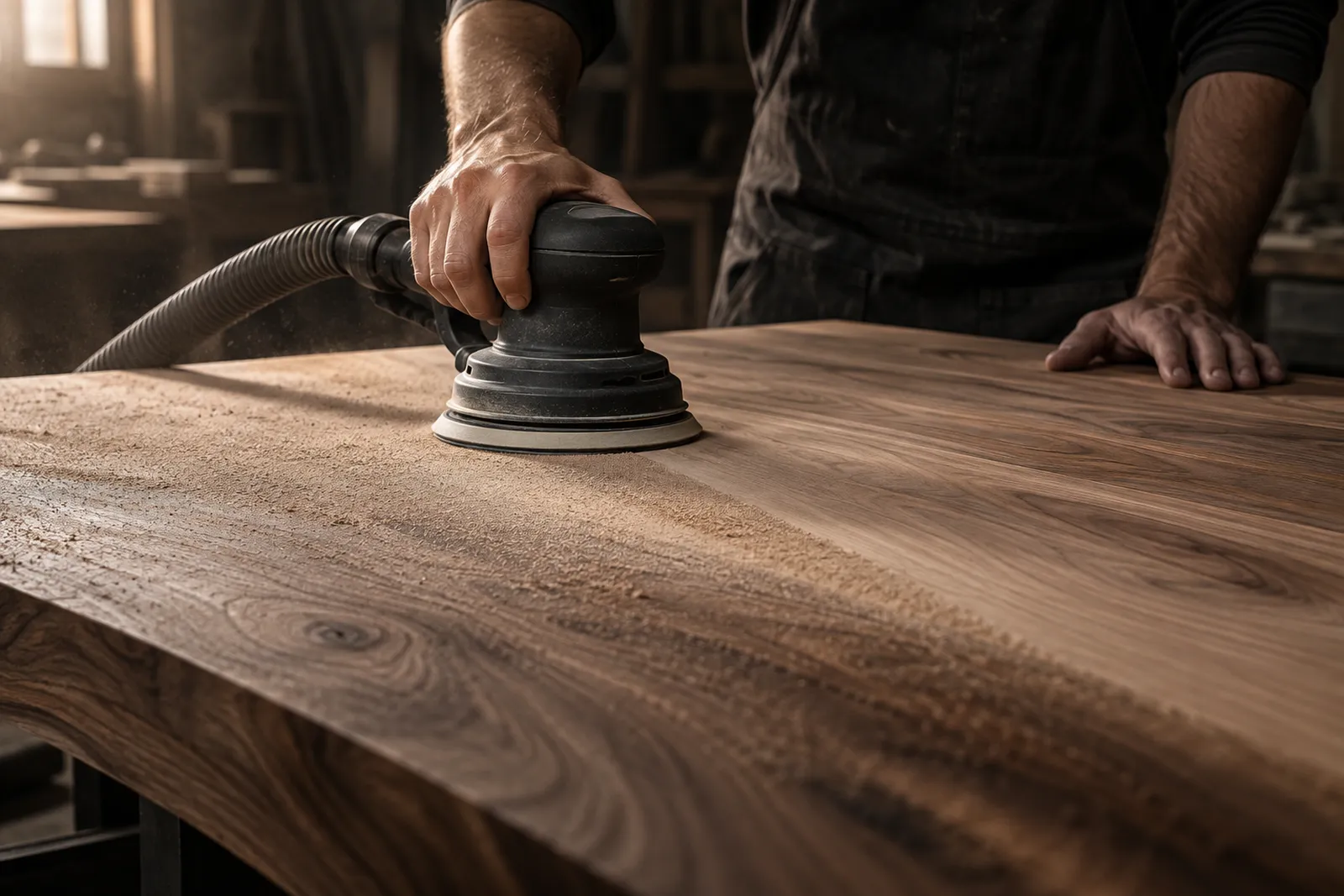
Raw solid wood: P80 removes saw marks and planer marks, P120 smooths, P180 or P240 gets the surface ready for oil, wax or varnish. Always sand with the grain, and with a random orbital sander don’t push – the machine does the work.
Going finer than P240 is rarely worth it before oiling: wood that is too smooth absorbs less oil, and the colour looks flatter. Before varnish, P240 is right; between two coats of varnish, P320 to P400 as an intermediate sand.
Removing old finishes
Between steps: remove dust, check the grain
Before every finer grit, vacuum or brush off the dust. Coarse grains left on the surface would otherwise keep scratching under the fine disc.
By hand, always sand with the grain, never across it – cross-grain scratches show up immediately under oil and stain. After the random orbital sander, a last pass with the same grit on the hand block along the grain is worthwhile: it removes the machine’s fine swirl marks.
Softwood, hardwood, veneer
Softwoods such as spruce or pine sand quickly, but resin clogs the paper. Mesh discs and changing more often help; the sequence stays P80 to P180 or P240.
Hardwoods such as oak or beech take longer per step, but need no different sequence. Oak has open pores – here it is especially worth stopping at P180 to P240 so the oil can soak in.
Veneer is often only a fraction of a millimetre thick. Never start with P80; start with P180 or P240, without pressure and by hand on edges – once sanded through, it cannot be saved.
FAQ
Do I have to start with P40 on wood?
Only if old paint or deep damage has to come off. Raw, planed wood usually starts at P80 or P120.
Why not sand finer than P240?
Wood sanded too fine closes its pores – oil and stain then soak in unevenly. For varnish P240 is enough; you key between the coats.
Terms in this article
All terms in the sanding glossary →The whole sequence at once
4 grits, 1 × smallest pack each: PRO CUT 150 (10 pcs) P80 · P120 · P180 · P240.
Or as a set: Wood starter set (P80–P240) for €49.90 →
incl. VAT, plus shipping