Car & paint · 2 min read
What grit for sanding body filler?
P80 to shape, P120 to P180 to feather the edges, P240 before primer surfacer – and why body filler is never sanded with P400.
Last updated: · published
KORNDEX sells abrasives – matching products are linked below the article.
Start coarse
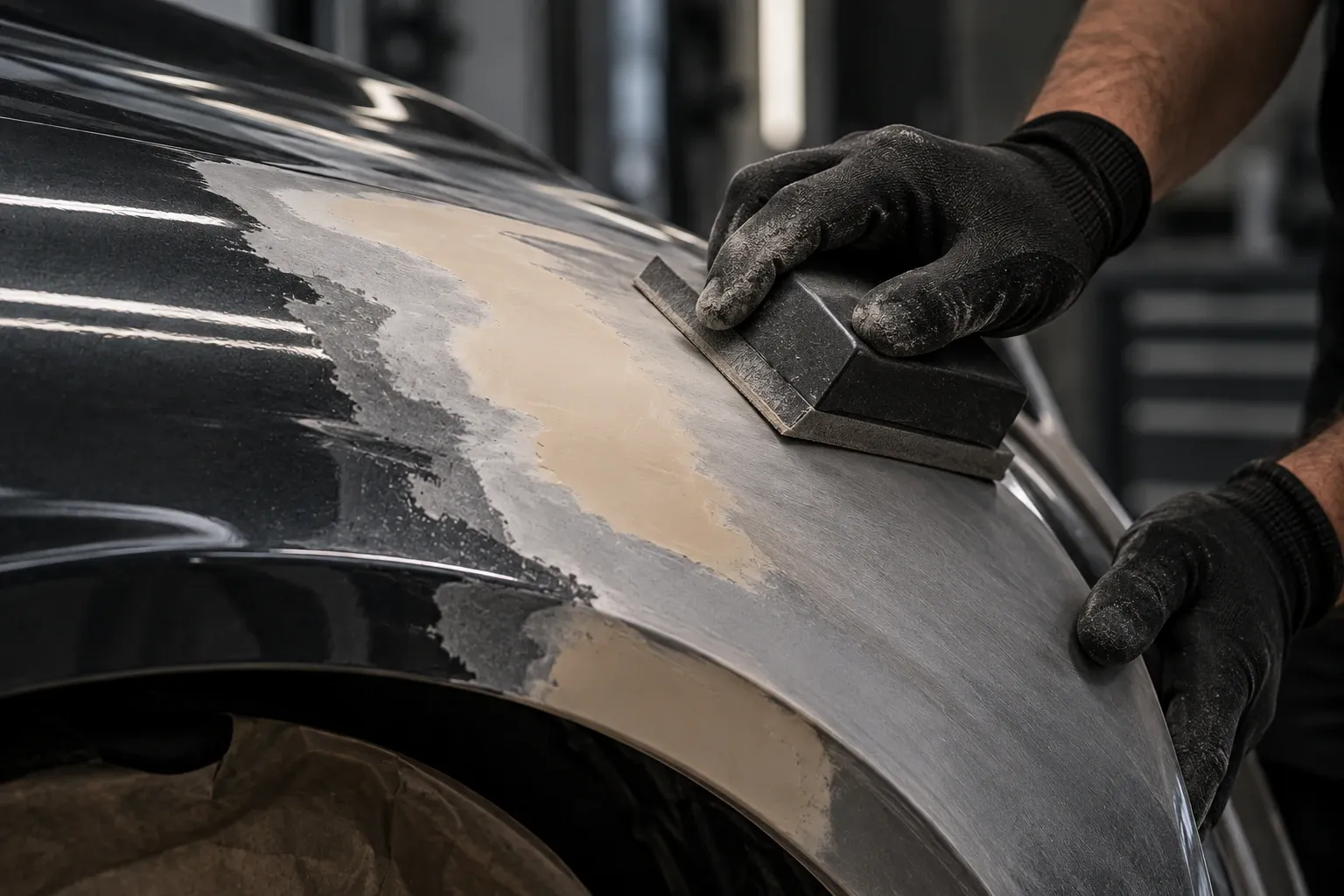
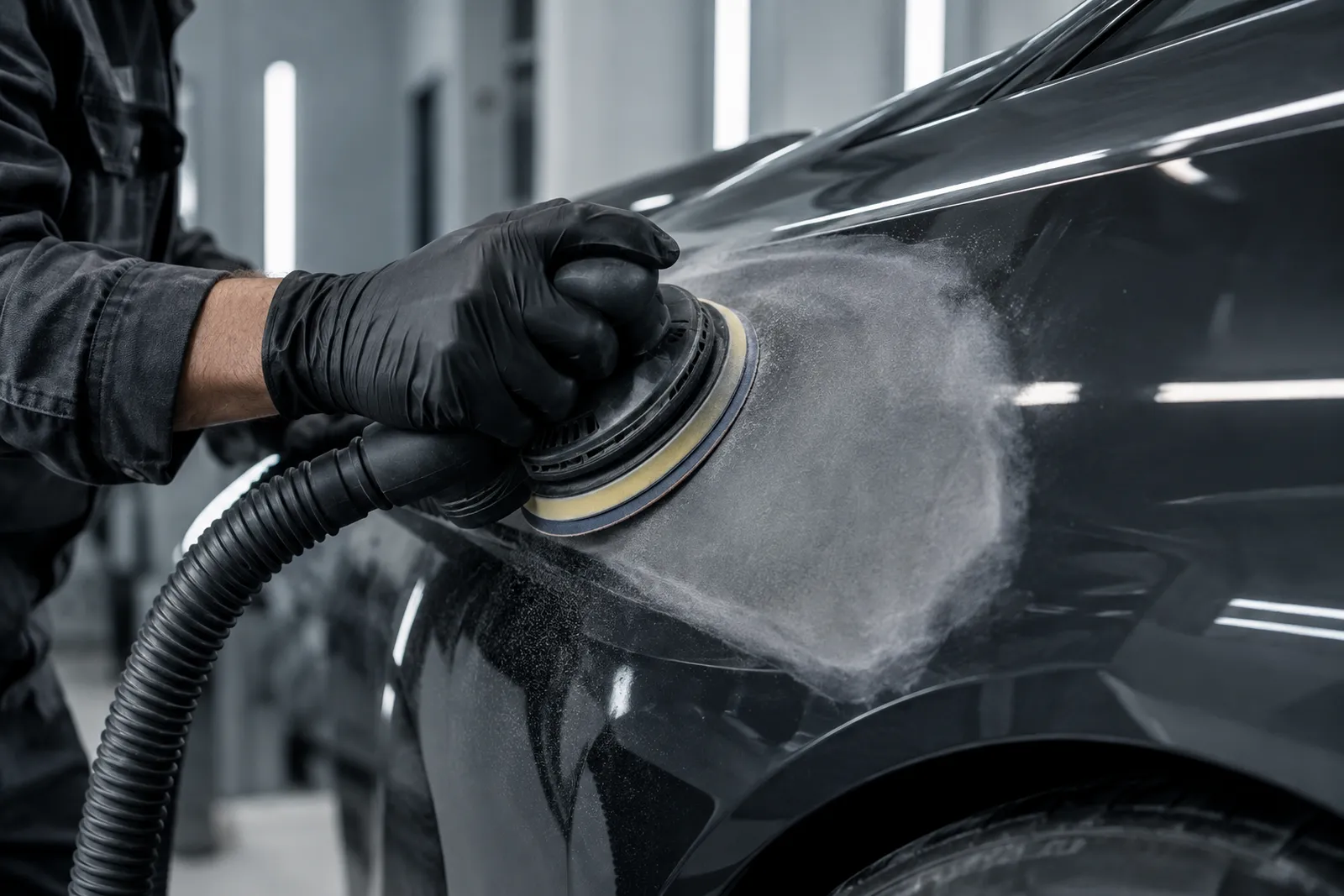
Polyester body filler is hard and stands proud. With P80 on the random orbital sander or the hand sanding block it takes shape quickly; starting finer only costs time and discs. On the hand block you sand flat surfaces – the block shows you where material is still missing.
With P120 and P180 you feather the edges into the old paint until you cannot feel a step. P240 is the last step before primer surfacer: the primer fills the scratches of P240, not those of P80.
Finishing filler
Why not P400
Primer surfacer needs a key: the scratches of P180 to P240 give it grip. A filler repair sanded almost smooth with P400 offers less of that, and the fine disc quickly clogs on the soft filler. Fine sanding only starts on the primer surfacer.
Checking and typical mistakes
Apply guide coat to the filler, then go over it with the hand block: whatever stays black sits lower and needs more filler. Also run your flat hand over the area – ideally wearing a glove; you often feel steps before you see them.
The most common mistake is sanding past the filler into the old paint with P80. Primer surfacer does not reliably fill coarse scratches in the paint. So feather the edge with P120 to P180 first.
Filler applied too thick costs the most time when sanding. Better to apply several thin layers and rough-sand in between.
Sanding body filler: by hand or by machine?
Large filled areas are faster and flatter with the random orbital sander and a hard backing pad – the machine takes off the peaks without following into the valleys. With dust extraction the disc stays open and you can always see how far you have got.
By hand with the hand block works on small spots, on swage lines, edges and curves, and anywhere a straight line has to be right: the long block bridges dents and shows where material is still missing. In practice you combine both: coarse with the machine, edges and borders by hand.
FAQ
How long does body filler need to dry before sanding?
Depending on temperature, polyester filler can be sanded after 20 to 30 minutes. If it smears or clogs the disc straight away, it has not fully cured.
Can I wet sand polyester body filler?
No. Polyester body filler is porous and soaks up water, which later comes out as blisters or rust under the paint. Always sand body filler dry, with dust extraction.
Terms in this article
All terms in the sanding glossary →The whole sequence at once
4 grits, 1 × smallest pack each: PRO CUT 150 (10 pcs) P80 · P120 · P180 · P240.
Or as a set: Car paint starter set (P120–P600) for €69.90 →
incl. VAT, plus shipping